
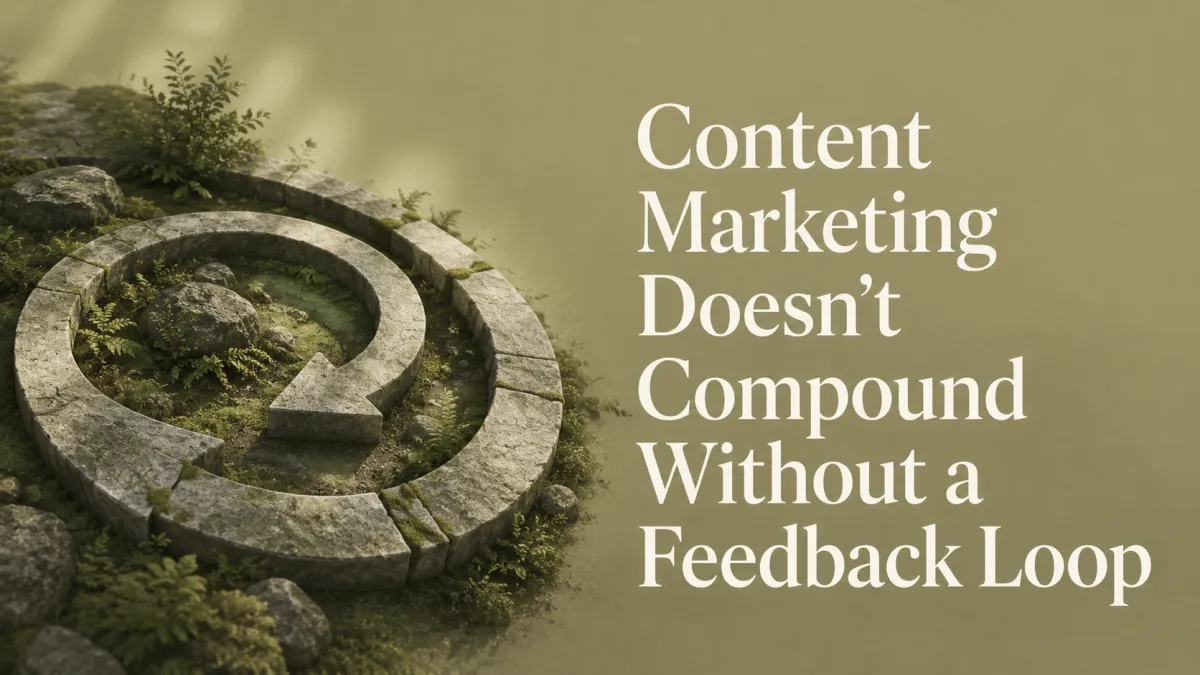
Content Marketing Doesn’t Compound Without a Feedback Loop
Most companies that “do content marketing” are really just running a publishing calendar. A blog post goes out every other week. A few social captions get scheduled around it. Someone checks traffic at the end of the month, sees a modest bump, and calls it working.
Six months in, the volume of content has grown, but the return hasn’t. Traffic plateaus. The same handful of topics keep getting recycled because nobody has time to find new ones. The blog exists, but it isn’t building anything. It’s accumulating, not compounding, and the team can feel the difference even if they can’t name it.
The mistake is treating content as the output instead of the point. Content is not the thing that creates authority. It’s what carries an insight to an audience and brings a reaction back. Without that loop, publishing becomes a treadmill: effort in, marginal traffic out, no compounding return.
Stone Soup Strategy calls the alternative the Narrative Flywheel: a six-stage model for how content compounds into trust and authority over time. An insight becomes a message. A message becomes content. Content gets distributed on purpose. The audience responds. That response becomes the next insight. Run the loop consistently, and each cycle gets sharper than the last.
Here is how that loop applies to an actual content marketing effort.
1. Start With Insight, Not a Content Calendar
Before any post gets written, ask where the actual insight is coming from: a pattern in sales calls, a question customers keep asking, a belief the founder holds that the market hasn’t caught up to yet. A content calendar filled with generic topics, the “5 Tips for X” kind, has no insight behind it, which is why it produces information without a point of view. It fills a slot on the calendar without moving anyone closer to trusting the company.
2. Translate Raw Insight Into a Core Message
Raw insight isn’t yet useful to an audience. It has to be translated into a clear, sayable point of view: one sentence that captures what you believe and why it matters to the reader. If the insight can’t survive being stated in a sentence, the content built on top of it will wander, and the reader will feel that wandering even if they can’t quite articulate why the piece didn’t land.
3. Turn the Message Into Content
Only at this stage does format matter: an article, a LinkedIn post, a case study, a short video. The same message can and should show up in multiple formats, because different parts of the audience consume differently. What keeps this from becoming scattered is that every format expresses the same underlying message, not a new idea each time it gets repackaged.
4. Distribute With Intention
Publishing is not distribution. Distribution means deciding, before anything goes live, who specifically should see this and where they already pay attention. A well-written article with no distribution plan behind it is a message in a bottle. This is also where paid amplification, outreach, and partnerships earn their place: not as a substitute for the message, but as a way to get a good message in front of the right people faster.
5. Treat the Response as Data, Not a Vanity Metric
Comments, replies, sales-call questions, and even silence are signal. A post that gets shared but never discussed is telling you something different than one that gets three thoughtful pushbacks in the comments. Most companies track opens and clicks and stop there. The response itself is worth reading closely, not just counting.
6. Let the Feedback Sharpen the Next Insight
This is the stage most content calendars skip entirely, and it’s the one that actually produces compounding. What the audience pushed back on, misunderstood, or asked follow-up questions about becomes the raw material for the next piece. Over time, this is what separates a company that publishes a lot from one that visibly gets sharper in public, month over month.
Content Marketing vs. a Content System
None of this eliminates the practical mechanics of content marketing: a blog, a publishing cadence, keyword research, multimedia formats, analytics. Those still matter, and none of them get easier to skip. What changes is what they’re in service of. An SEO strategy attached to a real point of view compounds, because each piece reinforces the same underlying authority. An SEO strategy attached to generic, insight-free posts produces traffic that never quite turns into trust.
The Real Test
The clearest sign content marketing is working isn’t a traffic graph. It’s whether this month’s piece reflects something sharper than last month’s, because the company actually learned something from how the last one landed. If every post could have been written a year ago without changing a word, the loop isn’t running. The content is just accumulating.
Most companies don’t need a bigger content calendar. They need the content they’re already producing to start talking back to them. Stone Soup Strategy helps build that loop from the first insight through distribution and back again, so content stops being a task to check off and starts becoming the system that builds the company’s authority over time.
--
David Shay
Founder - Stone Soup Strategy
