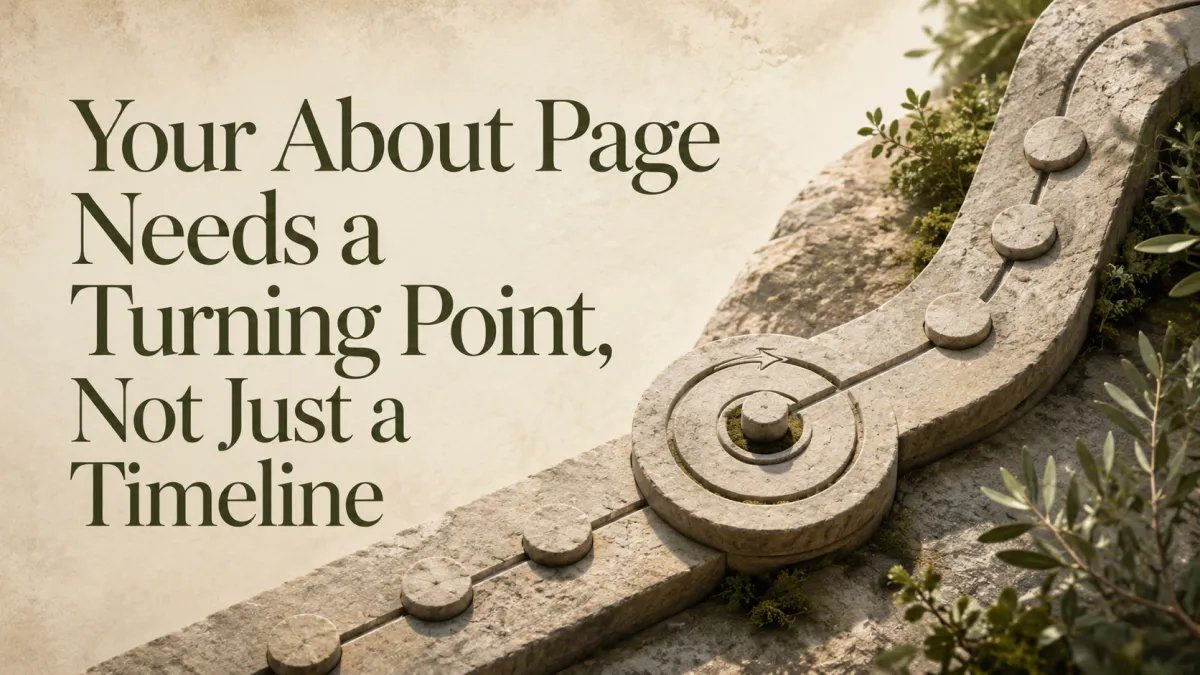
Your About Page Needs a Turning Point, Not Just a Timeline
Most About pages read the same way: “Founded in [year] by [name], [Company] set out to [mission]. Today, we serve [number] clients across [number] industries.” Every fact in it is true. None of it is a story. It’s a timeline: a sequence of events in order, with nothing at stake and nothing left uncertain along the way. A reader can skim it in ten seconds and retain almost none of it an hour later, because nothing in it asked them to feel anything.
A timeline lists what happened, in the order it happened, with no real suspense about where it was heading. A story requires a moment where the outcome genuinely could have gone the other way: a point where a safer, easier option was sitting right there, and something else was chosen instead, without knowing yet whether it would work. Remove that moment, and a reader is simply being informed. Keep it in, and they have something to actually care about, because now there’s a question hanging over the sentence instead of a fact being reported.
What a Timeline Leaves Out
Founders often edit the uncertain moments out of their own story without noticing they’re doing it, because those moments feel like weaknesses: the year they nearly took a safer, more conventional path. The client who almost didn’t come back. The point where the whole thing could reasonably have folded, and didn’t only because of a specific decision made under real doubt. These are exactly the parts a reader would remember, and they’re almost always the first thing cut in the polished version, because a professional editor’s instinct is to remove anything that sounds like a weakness, when it’s actually the only part of the story doing any narrative work at all. This is usually the first thing Stone Soup Strategy asks founders to dig back up when building out a real narrative, because it rarely survives the first draft on its own.
Three Questions That Turn a Timeline Into a Story
1. What was the safer, easier option we didn’t take, and why didn’t we take it? This names the road not traveled, which is what gives the road actually traveled any weight at all.
2. What moment made us genuinely doubt whether this would work, and what happened right after it? Doubt is the ingredient most bios remove first, and it’s the one moment a reader can actually relate to, since almost everyone has stood in that exact spot in their own work at some point.
3. What would have happened if we’d made the other choice? Naming the alternative outcome, even briefly, is what turns a list of facts into something with real stakes attached. It doesn’t need to be catastrophic. It just needs to be genuinely different from how things actually turned out.
A Turning Point Doesn’t Need to Be Dramatic
This doesn’t require a near-bankruptcy story or a dramatic pivot. A quieter moment carries just as much weight: a single client conversation that reframed the whole direction of the business, a competitor’s misstep that revealed an opening nobody else had noticed yet, a slow year that forced a decision the founder had been avoiding. The scale of the moment matters less than whether it was genuinely uncertain at the time it happened. Manufactured drama reads as manufactured, and readers are better at detecting it than most founders assume. A small, real moment of doubt reads as true, because it is, and because the specific, unglamorous detail is exactly the kind of thing nobody would bother inventing.
Why This Builds Trust, Not Just Interest
A story willing to include the moment of doubt signals something a highlight reel never can: that the founder is telling the truth, including the parts that don’t flatter them, which is precisely the kind of signal a reader has learned to look for after years of reading polished, interchangeable About pages that all promise the same competence. That signal does more to build trust than any claim about mission or values ever could, because a reader can’t verify a mission statement, but they can recognize honesty about uncertainty when they read it. This moment usually has to be asked for directly, more than once, before it surfaces in a form worth using, since founders rarely volunteer it unprompted.
The Test
Read the company’s current About page and ask whether anything in it could have gone differently. If every sentence reads like an inevitable march toward the present, the turning point is still missing, and the story is doing informational work instead of narrative work. If there’s a moment where the reader genuinely doesn’t know what happens next, even for a sentence or two, the story has already done something a timeline never will. Try reading it to someone unfamiliar with the company and watch where their attention actually sharpens. That’s usually the moment worth building the rest of the story around.
A timeline tells a reader what happened. A story tells them what it cost to get there, and what could have gone wrong along the way. Stone Soup Strategy helps founders find that turning point in their own history and build the narrative around it, instead of another accurate, forgettable list of dates.
